
 by George Welty
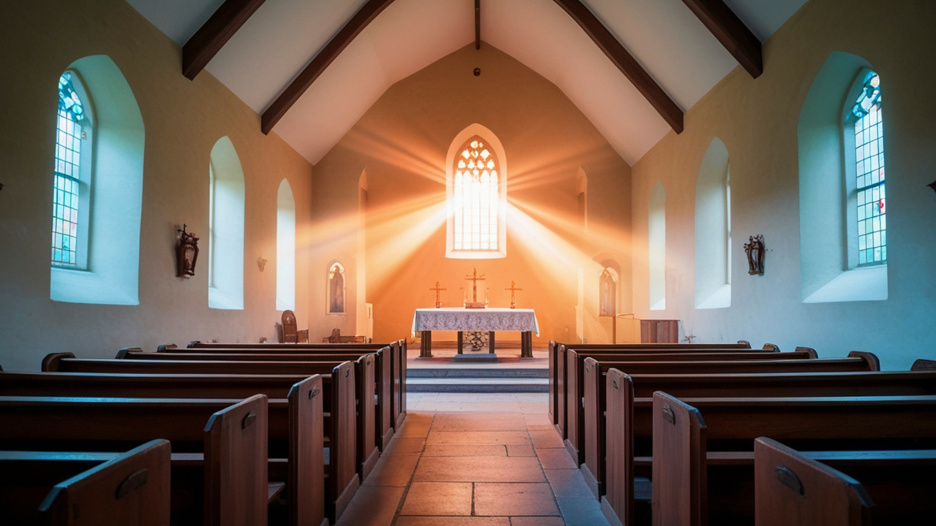 I grew up in the Churches of Christ, with multiple generations of family on both sides planted firmly in that world. So, when I eventually found myself serving as a consultant in the Episcopal Church, it was not exactly the kind of plot twist anyone from my childhood could have predicted.
For a person raised in a tradition where worship is often intentionally simple, entering the Episcopal world felt a little like falling down a rabbit hole and discovering that Christian worship could come with candles, incense, vestments, and a vocabulary that sounded like it had been preserved in a cathedral attic. I was not in danger of becoming Episcopalian, but I was very much in danger of asking too many questions. So, I did.
That curiosity turned into a kind of professional sightseeing tour through liturgical Christianity. I learned that liturgy is, at its simplest, the patterned work of worship: the shared prayers, readings, gestures, and responses that shape a congregation over time. It is not just about being formal for formality’s sake, though it can look that way to the uninitiated. It is about forming a people through repeated practice, so that worship assemblies are not merely something the church attends, but something the church does together.
Even without any hidden Episcopalian ambitions lurking in the background, I could see the wisdom of it. These practices were not just aesthetic extras for people who enjoy memorized prayers. They were tools for unity and spiritual formation. And that is what makes liturgical rhythms worth paying attention to, even for churches that have never thought of themselves as high church at all.
Exploring the Liturgical Calendar
I also learned the liturgical calendar, which is the church’s way of telling time by the life of Christ rather than by the school calendar or the monthly calendar. Advent, Christmas, Epiphany, Lent, Holy Week, Easter, Pentecost, and Ordinary Time give the church a rhythm that returns year after year, training attention and memory in ways that a purely improvised schedule rarely does.
Churches can start simply by naming the season from the front, explaining what it means, and giving people small practices that let the calendar move from theory into ordinary life. Advent can become a season of waiting and hope rather than just a hectic countdown to Christmas. Lent can give families space for repentance, prayer, and self-denial. In that sense, the liturgical calendar is a steady invitation to enter the story of Jesus together and to build family rhythms that are less reactive, less hurried, and a little more spiritually sane.
Exploring the Liturgical Rhythms of Worship
When I look back on my church background, I can see that we had liturgical rhythms whether we admitted it or not (think two songs and a prayer). They were just unwritten, which meant everybody knew the rules until somebody new showed up and accidentally broke them. We may not have had a prayer book, but we absolutely had patterns: when to stand, when to sing, when to be quiet, when to offer the invitation, and how long a sermon was allowed to run before people started spiritually checking their watches.
I saw a small version of this at Oikos Church, a church plant I recently visited in Memphis, TN. They used the Episcopal prayer of absolution before communion, and they recited the Apostle’s Creed together. Even though I am no longer connected to the Episcopal Church, some of those words still felt like home, which was a surprise to me in the best possible way. What I found there was a reminder that liturgical rhythm does not belong only to liturgical groups. It can become a gift to any church willing to let ancient words, shared prayers, and repeated patterns help form a people who are attentive, rooted, and open to the Spirit.
About the Author
George Welty has spent thirty years serving as a teacher, coach, minister, photographer, storyteller, and spiritual director, with a deep heart for ministry and formation. He is a D.Min. student at Lipscomb University and is passionate about exploring the beauty of God’s story and inviting the curious into the adventure of faith.
Leave a Reply