
 by Evertt Huffard
 Accountability in Christian ministry begins in a relationship with the Lord Jesus Christ. The Messiah gave his disciples a mission in life, a community to thrive in, and a promise to be with them. He modeled accountability to the Father and called all disciples to imitate him. “If you keep my commandments, you will abide in my love, just as I have kept my Father’s commandments and abide in his love” (John 15:10 ESV).
Christian discipleship implies the willingness to follow, imitate, and serve the Lord, since we abide in Christ. Thoughts and behaviors are anchored in Christ. Jesus said, “Whoever abides in me and I in him, he it is that bears much fruit, for apart from me you can do nothing” (John 15:5, ESV). Spirituality anchored in imitating Christ shapes our relationships with each other. “By this all people will know that you are my disciples, if you have love for one another” (John 13:35 ESV).
These four factors, illustrated below, offer a framework for assessing and developing accountability within a leadership team.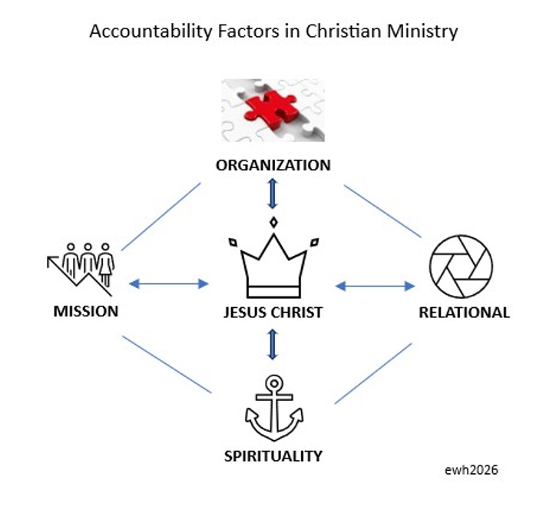
What Could Go Wrong?
When mature disciples of Christ serve together as elders, preachers, administrators, teachers, deacons, and missionaries, what could go wrong? If Jesus is Lord, what could possibly go wrong? Well, if we start with Lencioni’s list of dysfunctions of a team (2009) then expect to cope with the loss of trust, fear of conflict, lack of commitment, avoidance of accountability, and inattention to results.
If we add the personal dimension of the dark side that Rima and McIntosh identify (Overcoming the Dark Side of Leadership, Baker, 2007), then anticipate compulsive, narcissistic, paranoid, codependent, or passive-aggressive behaviors obstructing accountability. These behaviors drain energy from a team and destroy the trust that is necessary to manage conflict and maintain commitments. The battle between the flesh and Spirit can be anywhere. When leaders refuse to take the inward journey to explore and manage their dark side issues, expect some form of leadership failure.
What can be done? How could this model guide us through the rapids to process our own culpability, or as leaders create a healthy culture of accountability for a ministry team?
- Accountability can be one measure of the depth of the spirituality of any church leader.
Disciples of Christ anchor their spirituality in obedience to Christ and submission to his will. We welcome the tough conversations about their own work and behaviors, knowing the Spirit of Christ can speak to us through our brothers and sisters. Humility is more than acknowledging our own weakness and sins; it accepts direction and mentoring. The longer a leadership team avoids difficult conversations, the greater the collateral damage and drain on the energy of the team.
- Accountability to Christ results in a selfless concern for everyone on the team.
Accountability is deeply relational. The lack of accountability poisons a network of relationships. Submission to one another energizes a team as each member submits to the spiritual gifts of others on their team. Give your team permission to hold you accountable, even in a difficult conversation. Be aware that when your dark side surfaces, your defensiveness destroys relationships, which is a sin of pride.
We stand in grace so we can own our mistakes and learn from them. A trait of emotional maturity is the ability to work well with others, to function within an organization, and under authority. One sign of a good team culture is the openness to coaching and a desire to always learn and grow in relationships as well as in tasks.
- Accountability can be discerned by effective engagement in the mission of Christ.
Jesus connected the mission of God to the authority that he received from the Father (Mt. 28:18-20). Members of a ministry team need to consistently evaluate their effectiveness, since busy work does not equate to bearing fruit. Peer pressure to meet team goals can create some accountability. When a team fails to meet agreed-upon goals and adjust accordingly, the elders have a responsibility to guide the team.
- Accountability at the core of the organization creates a culture that affirms spiritual gifts, minimizes turnover rates, and sets clear expectations for outcomes.
The organization of God’s people is organic to the extent that churches select the spiritually mature among them to shepherd, lead, and equip them to fulfill their mission. Church organization is the one place where the connectedness to Christ is the most difficult to maintain. When elders function as a corporate board of directors who manage funds and employs the staff, they struggle to hold each other accountable. The individualism within Western churches makes it extremely difficult to hold anyone accountable.
Consider three hypotheses that may be impossible to prove, but are worth discussing:
- The more influence that cultural norms and the size of the congregation have on the organization of a church, the further the organization drifts from Christ.
- Members in small churches have more accountability than those in larger churches. However, members of a ministry team in larger churches have more accountability than ministers in smaller churches.
- When elders work in partnership with a preacher or ministry leaders in adding full-time ministers, the ministry team will have greater accountability.
In the end, accountability in ministry is not merely a structural issue, it is a spiritual one. When leaders remain deeply rooted in Christ, they create a culture marked by humility, trust, and shared purpose. This kind of environment not only strengthens relationships but also sustains the energy needed to carry out the mission faithfully. As elders and ministry teams commit to honest self-reflection, mutual submission, and alignment with Christ’s mission, they position themselves to bear lasting fruit. Healthy accountability, grounded in grace and truth, becomes the pathway through which both leaders and their ministries thrive.
About the Author
Dr. Evertt W. Huffard is Professor Emeritus of missions and leadership at Harding School of Theology in Memphis, TN where he taught from 1987-2019. He also served as VP/Dean at HST from 1999-2014. He currently works part-time with church equipping for Mission Resource Network, a resource for consulting church leaders in the USA, and coaches church leaders in equipping emerging leaders internationally.
The son of church planters in the Middle East, he has also served among the Arabs in Nazareth, Israel. They have also served in an urban ministry in Los Angeles, CA.
Evertt has been involved in church consulting nationally and internationally for over 25 years. In 2017 he hosted three tour groups to Israel, excavated at Beth Shemesh, taught for a church leaders retreat in South Africa, and spoke for a retreat in Germany. In 2018 he has consulted for seven churches (in Montana, Colorado, Arkansas, Florida, Australia), attended the Middle East Consultation in Malta, and spoke for a conference of church leaders in Australia. He helped initiate the Shepherd’s Network at HST to encourage and to equip church leaders.
He is married to Ileene and they have three children and ten grandchildren.
Leave a Reply